sotir

822c3c63 70a0 4275 affe e114d91fa71a

Where to Put My Keywords

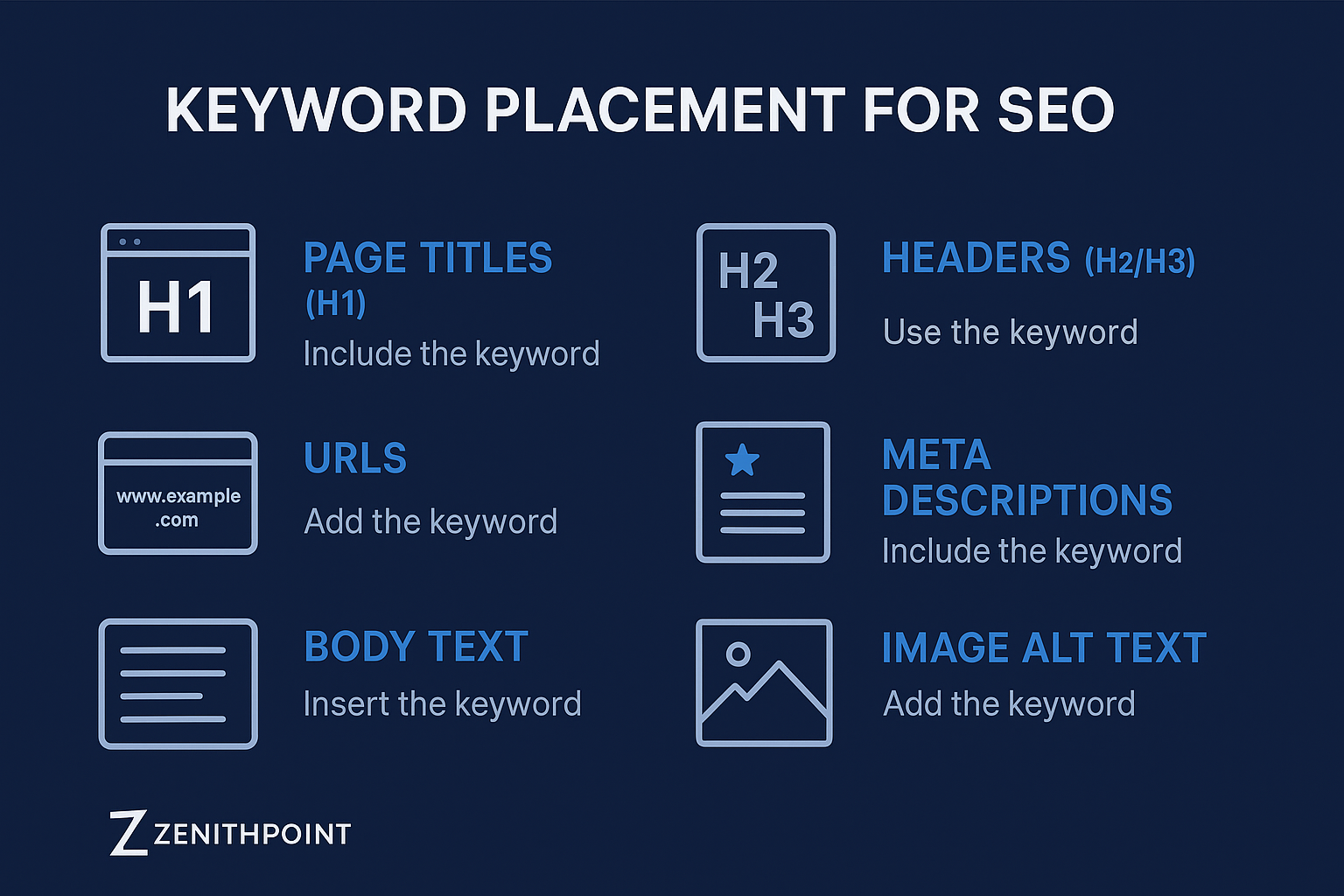
TL;DR Want people to find your site without paying for ads? Start by tucking keywords into smart spots. Place them in page titles, URLs, and headers (H1 through H3) so both visitors and search engines notice. Drop the main phrase within the first 200 words, then repeat about every 100 words to keep it natural. Don’t skip image ALT tags or the slim meta description; those slots matter, too. If you post videos or podcasts, a quick keyword-heavy summary helps. Finally, keep adding to FAQs or blog posts based on real questions your customers ask. Need a hand? Zenith Point Digital Marketing fine-tunes keyword placement for lasting growth. Why Keyword Placement Matters SEO isn’t just a fancy buzzword; it’s a strategy to guide people from Google straight to your door. When someone searches for a service you offer, you’re hoping your exact terms greet them on the first page.Place those terms where search crawlers look first and you’ll beat the odds. The sad truth is, most folks never scroll past Page 1, and Pages 2 and 3 might as well be blank walls. Getting the layout right can lift your site higher and pull in traffic that’s not paying a dime for ads. Start With Keyword Research Grab some search data before anything else. Good words create an unseen pathway linking customers to your homepage. Without solid research, the trail disappears fast. For a deeper look, check out guides like Using Keywords to Improve Your SEO and Adding Keywords for SEO. Identify Your Keywords Solid phrases share a few traits: Keywords usually fall into two buckets: Short-Tail Keywords squat in broad territory. Think running shoes or deck builder. Those terms pull giant search volumes but bring tons of rivals. Long-Tail Keywords drill down for specifics. Phrases like best shoes for marathon training or affordable deck contractor in Austin get smaller crowds. The upside? They tend to convert well once visitors land on the page. Tools to Use Plenty of platforms help, yet most people overthink it. Pick software that lets you: If that feels tedious, services such as Zenith Point can hunt for opportunities so you don’t have to. You can also explore GoDaddy’s guide on finding and adding keywords for more practical tips. Where to Place Your Keywords Grab your final list and weave the words through existing copy. Titles, headers, and early paragraphs earn priority. Lean on rhythm, not repetition, so readers never spot the mechanics. Page Titles and Headline Tags Every time Google looks at a new web page, the title box—that’s usually the same thing as the H1 tag—shouts loud and clear. If you’re trying to land jobs as an industrial electrician, for instance, your header could read Industrial Electrician Services in Portland. The moment a visitor arrives, that line tells them exactly what they’re about to see. H2 & H3: Subheadings H2 and H3 tags function like signposts, letting search engines map how your content fits together. Slipping in related keywords here gives those signposts extra weight. For example:H2: Why Choose an Experienced Industrial ElectricianH3: Safety and Compliance in Electrical Installations URL Slugs A tidy URL stays short and still manages to name the game. www.yoursite.com/industrial-electrician sounds straightforward. www.yoursite.com/page12345 feels like reading a grocery list of cereal brands. First Paragraph (First 200 Words) Dropping your main keyword in the opening lines helps Google get the point before it even finishes loading the page. Body Text Drop the target phrase naturally once every 100 words or so, then walk away. If the write-up stretches to 1,000 words, saying best shoes for running eight or nine times still feels human. Meta Descriptions Those few lines under your link in a search-result page serve as a free billboard. Pack one or two keywords inside and phrase it in a way that makes somebody want to click. Why Alt Text Matters A search engine can’t peek at a photo but can read the words you tuck inside the Alt tag. Use that space to drop the same keyword visitors might type. Alt-Text Sample:industrial-electrician-wiring-circuit-panel-0123.jpg reads much smarter than photo123.jpg. Videos and Podcasts Google neither sees faces nor hears voices, yet it loves plain text. Write a short summary of every clip you post so crawlers know the topic and feel comfortable indexing. Skip the Keyword Clog Stuffing the same keyword into every sentence is like pouring too much salt: it ruins the flavor and likely pushes readers away. A good rule? Use it once, gloss over it, and don’t barely notice. Write Like You Talk When the keyword fits naturally, cool. If it sounds stiff, swap in a close synonym or flip the sentence around so the keyword tags along without complaining. Topics come first, rankings follow. Build the Web with Fresh Pages New articles, guides, and lists circle back to your focus term faster than any fancy tool. Each fresh post shouts hey, I’ve got more that matches that phrase you just googled. Long-Tail Up for Grabs Odds are someone typed best sneakers for long runs on concrete, not running shoes. Repeat questions start popping up? Draft an FAQ page and let those narrower phrases breathe. Add Blog Posts Start a fresh blog whenever you’re curious about what customers really want to know. Real questions become useful articles, and useful articles make your site feel alive. When you dig into those topics, Google tends to notice and rewards you with extra credibility. Quick Win: Slip secondary terms into the headings, and tuck the main phrase into the opening 200 words where it feels natural. How Zenith Point Digital Marketing Can Help Zenith Point specializes in making SEO simple from day one. We hunt down keywords that will truly move the needle for your business, then show you where and how to insert them. Whether you’re launching a brand-new site or polishing an older one, our data-backed playbook keeps your pages ranking high and converting even higher. Let our team handle the number-crunching around keywords so that you can

Where to Put My Keywords Read More »
52e53205 4ca1 4542 a42e c19c28994ce1

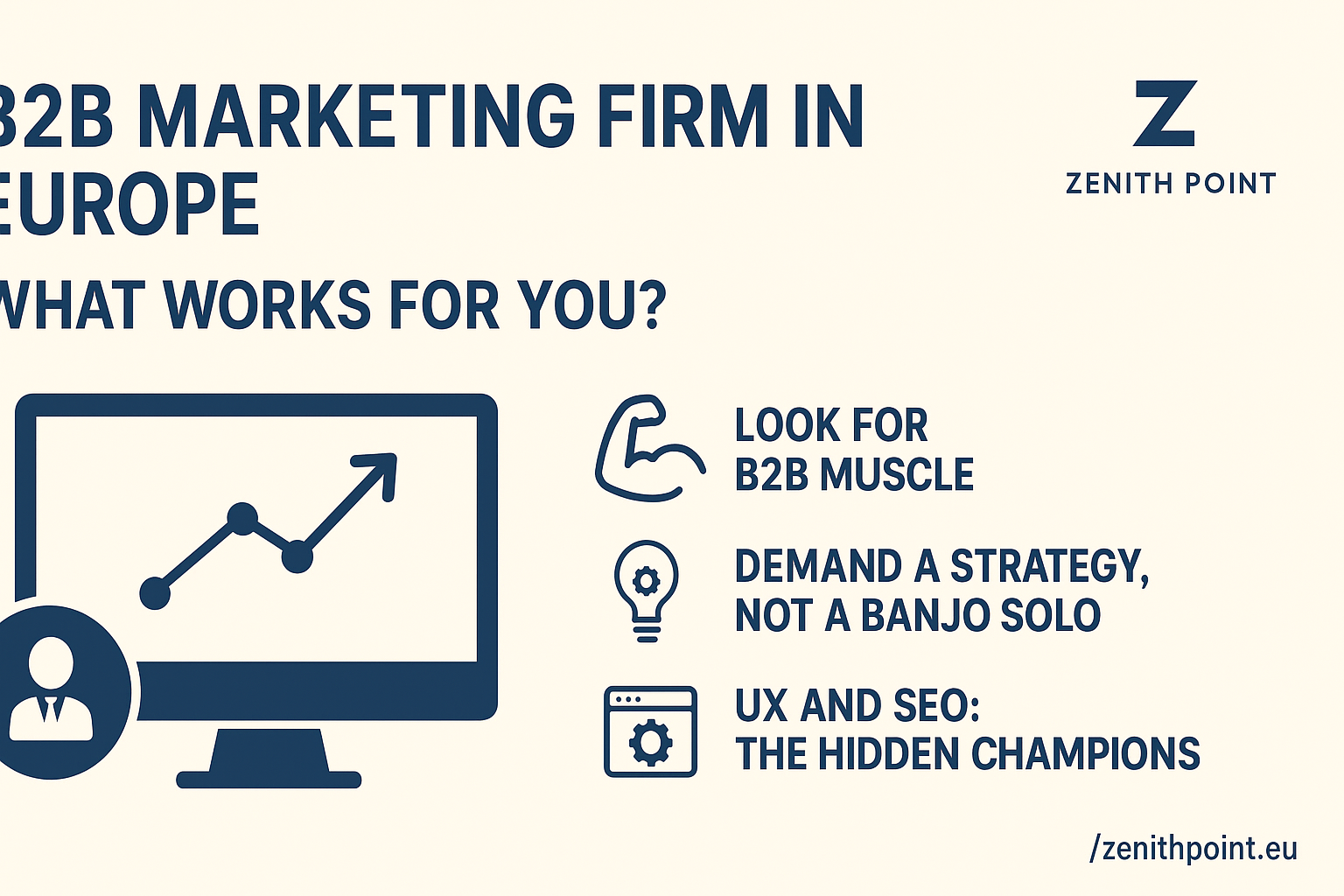
B2B Marketing Firm in Europe: What Would Fit You?

TL;DR If you’re a B2B company looking to grow in Europe, the right marketing firm can make or break your success. This guide outlines how to evaluate B2B marketing agencies in the European market, what to look for, and why user experience features like breadcrumb navigation still matter in 2026. We also explore how a specialized agency like Zenith Point can provide the actionable strategies you need. Understanding the European B2B Landscape Why Europe is Unique for B2B Marketing The European market is diverse, multilingual, and driven by regional nuances in behavior, regulation, and technology adoption. A pan-European B2B strategy must therefore balance consistency in messaging with flexibility for local adaptation. A European B2B marketing firm should understand: How to Choose the Right B2B Marketing Firm in Europe 1. Assess Their B2B Specialization Unlike B2C, business-to-business marketing requires depth in buyer psychology, long sales cycles, and relationship-driven tactics. Make sure your agency has a proven track record in: 2. Demand a Strategic Foundation The best firms don’t just execute; they build a long-term growth strategy based on data. A suitable B2B marketing partner will offer: 3. Look for UX & SEO Expertise It’s not enough to have a good-looking website. It needs to function like a conversion machine. UX (User Experience) and SEO (Search Engine Optimization) are critical in ensuring visibility and engagement. Here’s where breadcrumb navigation becomes unexpectedly crucial. Breadcrumbs: The Forgotten Hero of B2B Web UX What Are Breadcrumbs? Breadcrumbs are a secondary navigation tool that helps users understand where they are on a website. Typically displayed as text links (e.g., Home > Blog > Marketing Tips > This Article), they serve multiple roles: Are Breadcrumbs Still Relevant in 2026? Absolutely. Studies and user testing consistently show that breadcrumbs provide mid-sized usability benefits with virtually no downside. Jakob Nielsen, a leading usability expert, has long advocated for their use. And modern research shows: When to Use Breadcrumbs on Your B2B Site FAQ: The Importance of Breadcrumbs in 2026 Why should I care about breadcrumbs as a B2B marketer? Breadcrumbs improve user experience, reduce bounce rates, and boost SEO—critical metrics in any B2B strategy. Do users even notice breadcrumb trails? Yes. While some users ignore them, testing shows that those who notice them use them efficiently, with zero confusion. Should breadcrumbs show user history or site hierarchy? Always site hierarchy. Path-based (history-style) breadcrumbs are redundant because browsers already have back buttons. Location-based breadcrumbs give more context and usability. What’s the best design practice for breadcrumbs? What Makes Zenith Point Different When evaluating a B2B marketing firm in Europe, consider what Zenith Point brings to the table: Strategic, Not Just Tactical Zenith Point doesn’t just run campaigns—they build ecosystems. With a data-first approach, they help B2B companies navigate the complex European market. UX and SEO Excellence Their websites are not only beautiful but functionally engineered for results. They incorporate usability best practices like breadcrumb navigation, mobile optimization, and structured data to improve performance across the board. Industry-Specific Expertise Zenith Point understands the unique challenges of sectors like SaaS, fintech, and manufacturing—making them more than just marketers; they’re domain experts. What to Do Next If you’re in charge of marketing for a B2B organization in Europe, it’s time to: Final Thoughts Choosing the right B2B marketing firm in Europe isn’t just about who has the nicest website or the biggest portfolio. It’s about alignment with your goals, understanding your customers, and maximizing every user interaction—even down to breadcrumbs. In 2026, these small touches matter more than ever. Zenith Point helps B2B companies unlock growth through strategic marketing, optimized UX, and conversion-driven SEO. Breadcrumb navigation is just one of the many ways they make sure your site works for your business, not just with it. Ready to grow your B2B presence in Europe? Reach out to Zenith Point and start building a smarter, better-optimized marketing strategy today.

B2B Marketing Firm in Europe: What Would Fit You? Read More »

32cd8651 8cdb 4128 8749 d7966682eac5

Europe-Ready B2B Partner: Picking a Firm That Clicks

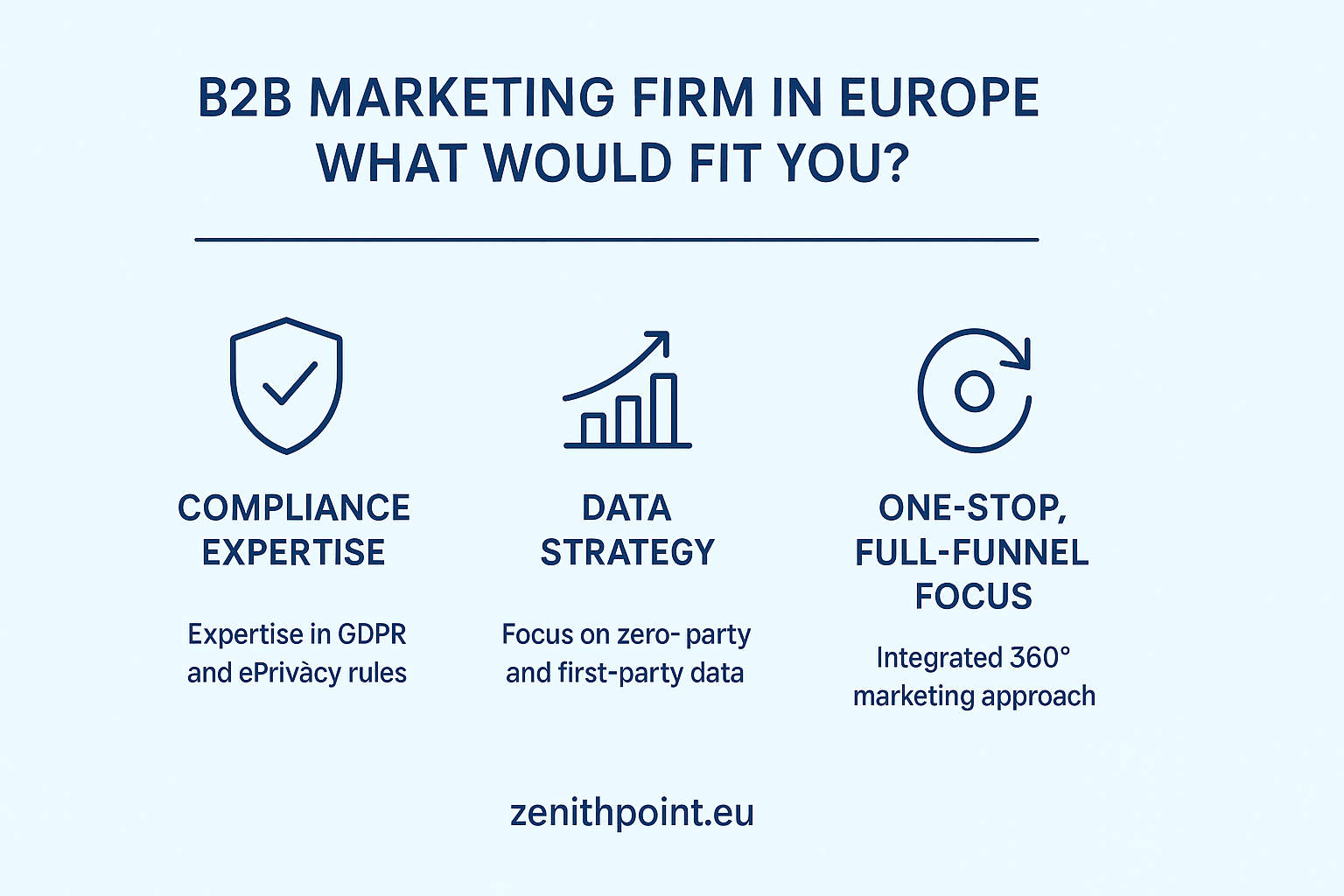
TL;DR: The ideal B2B marketing agency bounces off your market sector, legal must-dos, and sales targets. Companies focused on the DACH zone, fresh data rules, or all-in-one channel play need a guide like Zenith Point that custom-fits plans and keeps results honest. Study local laws, ditch one-size blast outreach, and build a conversation bank on clean data. Introduction: Why 2024 Feels Different Regulatory tweaks from Google, Yahoo, and the rest now ripple through every inbox. Stricter EU privacy fines keep companies awake, while buyers today want brands to read the room and act personal. If your brand is eyeing a bigger footprint in Paris, Berlin, or beyond, the right digital ally can make or break the trip. This piece walks you through the signals that say an agency gets Europe—and shows you how to sync that knowledge with a forward-looking plan. Why B2B Marketing in Europe Needs Its Own Game Plan Pushing a single message across Europe is rarely a winning move. DACH marketers know that permission rules shift with every border—Germany’s take on GDPR can feel worlds apart from Spain’s digital customs. A tactic that sails through Madrid may run aground in Munich. Learn more about adapting your strategy for European expansion in this LinkedIn article. Quick Headaches to Watch The partner you pick should already be fluent in these quirks and bend your campaigns around them—not the other way around. What to Demand From Your B2B Marketing Firm One Stop, Full-Funnel Focus Agencies worth their salt run 360° campaigns that connect every dot. Think social buzz, blog deep-dives, sharp SEO-optimized content, pay-per-click bursts, weekly emails, and CRM magic all in one rhythm. Buyers hear a steady beat from their first curious click to the moment they sign a contract. Choose a team that stitches those channels together so prospects never feel like they’ve jumped to another brand between steps. Compliance Expertise Nobody can afford to skip compliance anymore. Hitting the DACH or wider EU market means your marketing buddy must know their way around: Firms like Zenith Point weave these rules into the campaign plan from day one. Compliance isn’t tacked on later like a forgotten coffee order—it runs through the whole project like printed ink. Data Strategy Beyond Third-Party Cookies Third-party cookies are history, so it’s time to rethink your data playbook. Focus on two richer sources: Zenith Point leans on clean, ethical tracking stacks that stay inside GDPR lines while still answering the question every marketer asks: Who are these people, and what do they want? What B2B Outreach Methods Are Still Effective in 2024? Cold Emails: Proceed with Caution Email blasts look tempting but can sink fast under Europe’s tighter rules. To stay afloat, you must: Fail any of those and your carefully crafted pitch winds up in the spam graveyard. Check out this Business Reporter article for more insights on compliant outreach. Cold Calling: Still Viable A good phone call hasn’t lost its shine yet, at least when it isn’t a hard sell the second the receiver picks up. In fact, many B2B pros prefer a courteous ring over yet another cookie-cutter email. Relevance matters. If the service fits the firm and the tone is respectful, the call is often welcomed instead of dreaded. That makes dialing a surprisingly compliant lifeboat in the post-cookie storm. Social Selling: Be Smart, Not Spammy Social media gives you a microphone, but a one-size DM will sound like white noise. In many EU nations, bulk messages are treated just like cold emails and must prove consent to avoid fines. A note that sounds like a human sharing a relevant tip beats a robotic pitch every time. Read more on how international B2B marketing strategies are evolving in this We Are Marketing guide. Direct Mail: The Underrated Tactic Believe it or not, a stamped envelope still lands with a thud—no inbox needed. A handwritten card slips past GDPR headaches and feels personal in a world of pop-up ads. Send something clever on paper and watch competitors wonder how you broke through the noise. What Should a Compliant Marketing Toolset Look Like? Must-Have Features Platforms like Zenith Point help fit those pieces together so sales and marketing see the same customer journey. One dashboard shows how every campaign move stacks up—fines aside. Questions to Ask Potential Providers Where is your data hosted?A cloud server tucked behind a bank vault or stacked on a shelf in a basement makes a world of difference. How is it sourced?Are the records hand-scraped over coffee, pulled from APIs, or bought in bulk from a data broker? Can you provide documentation for legal review?Your lawyer will want a paper trail thicker than a paperback, so ask for terms, SLAs, and anything else they keep in a drawer. FAQ — In What Database Sites Should I Register My Business? Registering Your Business for Visibility and Credibility Setting up shop online isn’t just for browsers; it helps your B2B brand look serious. Bonus Tip Keep your Name, Address, and Phone Number the same everywhere. Consistency helps search engines trust you, which in turn boosts your visibility. How Zenith Point Digital Marketing Can Help Zenith Point isn’t your average agency. We build compliant, ROI-led B2B playbooks that speak the language of the European market. Whether you’re wrestling with GDPR rules, dodging email fines, or bracing for a cookieless web, our team can: We’re not just button-pushers. Think of us as a growth co-pilot for your European ambitions. Choose Smart, Choose Strategic The right B2B marketing partner doesn’t just pump out leads. They guard your brand, keep you ahead of compliance twists, and spend your budget like it’s their own. In a digital world tightening around privacy and personal touch, an ally like Zenith Point keeps you nimble, compliant, and winning deals. Make the savvy choice. Pick a team that knows Europe inside and out—and understands your business even better.

Europe-Ready B2B Partner: Picking a Firm That Clicks Read More »

60f61ce0 3f65 4964 973a 1e33713ea473

Digital Marketing Agency Europe for Startups TL;DR Every young company in Europe needs digital marketing—or risks being forgotten. An agency like Zenith Point can whip up a go-to-market plan, boost online visibility, and find budget-friendly tools that turn headliners into customers. The message is clear: invest in smart online tactics, and growth follows. Why Digital Marketing Matters for Startups in Europe A World of Competition, Limited Budgets Launching a startup feels electric, yet the thrill quickly meets hard reality. Sprinting toward sales, founders notice cash drains fast, and rivals never sleep. Classic billboards and TV spots eat money by the second, so a single bad choice can sting for years.Enter digital marketing. Precise, adjustable, and often cheaper than coffee for the team, it gives even toddler-sized brands a shot at standing shoulder-to-shoulder with industry giants. A Euro-based agency brings that know-how on day one, turning blurry goals into sharp campaigns before the first profit roll-in arrives. More Than Just a Website For many brand-new startups, the main focus is on perfecting the product. Marketing looks like an add-on, almost a chore they’ll get to later. The truth is, great products still vanish into thin air without a smart plan to share them with the world. These days, digital marketing means showing up where your audience already hangs out, hooking their attention, and nudging them toward a sale. Are Startups in Europe Embracing Digital Marketing? Experts like Joel Curado and Ksenia Tugay, as noted in GB News’ feature on digital marketing for startups, point out a curious pattern: the appetite for marketing changes with the industry. Retail newcomers usually jump online first thing, flashing ads and social posts without hesitation. Tech firms, on the other hand, tend to sit on marketing until that shiny MVP is ready. Seed money can flip the switch for a lot of teams, yet by then precious weeks—or months—might have slipped away. That sense of urgency is why some founders tap a digital marketing agency right from the jump. The pros build out ads, landing pages, and early campaigns so the team isn’t scrambling on 12 different screens at once. The Common Struggles Still, most young companies start with a short list of hurdles. A rock-solid go-to-market strategy is usually missing, along with sharp customer profiles and the rundown of which platforms actually work. Internal bandwidth is often swallowed by code tweaks and customer support, leaving zero time for Facebook or Google. That’s where an agency like Zenith Point can step in and shoulder the load. The founders stay hands-on with the product and business plan, while the marketing squad sorts audience targeting, budget breakdowns, and daily optimization. In the end, the startup gets speed, focus, and a fighting chance to grab attention before the moment passes. What Startups Should Shoot for with Digital Marketing Goal 1: Get NoticedA brand nobody knows isn’t a brand at all. Smart founders lean on technical SEO, lively social media posts, and well-timed pay-per-click ads to make their names pop up where curious eyes can see them. More visibility means more early customers—and a few impressed investors who just happen to be watching. Goal 2: Land New CustomersWeb ads aren’t a guessing game anymore. With crisp landing pages and finely tuned Facebook or Google campaigns, a startup can almost whisper its offer to exactly the people most likely to pull out a credit card. The trick is turning that fleeting click into a lasting sale. Goal 3: Look TrustworthyA polished website, a handful of sharp testimonials, and maybe a case study or two act like a digital handshake. When a brand puts its promise front and center, hesitation starts to fade. Partnering with a savvy agency helps make those trust-signals pop at just the right moment. Top Digital Marketing Tactics for European Startups 1. Landing Pages That ConvertDigital consultant Nhat Vuong swears by one-page wonders. Strip away clutter, spell out the benefit, and drive traffic from a tight campaign; the leads often follow faster than expected. 2. Social Ads with MuscleLinkedIn, Instagram, even Twitter let brands zero in on engineers, fashion lovers, or anyone in between. A lean budget doesn’t mean shallow reach; it just means starting smart and scaling quickly once the clicks start coming. 3. Content MarketingFresh blog posts, how-to guides, and quick videos do three big things at once. They boost your SEO, teach curious customers, and help your brand look like the top expert in the room. A good agency—say Zenith Point—will sketch out a content calendar and keep the machine humming week after week. 4. Email MarketingPeople keep saying email is dying, yet it still spits out one of the biggest returns on every dollar spent. By setting up a few automations and slicing your list into segments, a young company can nudge cold leads closer to the buy button without grinding its team down. 5. Organic and Paid Search (SEO & PPC)Landing near the top of Google for terms that matter to your audience sends steady, wallet-friendly visitors your way. If you want eyeballs right this minute, a set of well-crafted paid ads acts like a flashing neon sign while the free strategy gathers steam. 6. Influencer and Network MarketingA single post from the right influencer can double your visibility overnight, and your own contacts probably own a few megaphones, too. Leaning on those voices lets a lean startup punch well above its weight without emptying the marketing budget. Do Startups Need an Agency or Can They Go DIY? Many new businesses wonder whether they really need an outside firm or if they can wing it themselves. A quick scan of Google often leads to more questions than answers.Hiring a full-time marketing crew can drain cash almost overnight. Freelancers promise flexibility, yet coordinating half-a-dozen side-gigs usually turns into a second full-time job.A specialized agency serves up baked-in know-how that no founder picked up on day one. Pros of Hiring a Digital Marketing Agency Cross-Functional ExpertiseOne team handles paid ads, web code, copywriting, and

Read More »

f29fbd55 97f2 46f2 b4ed cedc4719fbfe

What Does AI Mean for SEO Tomorrow?

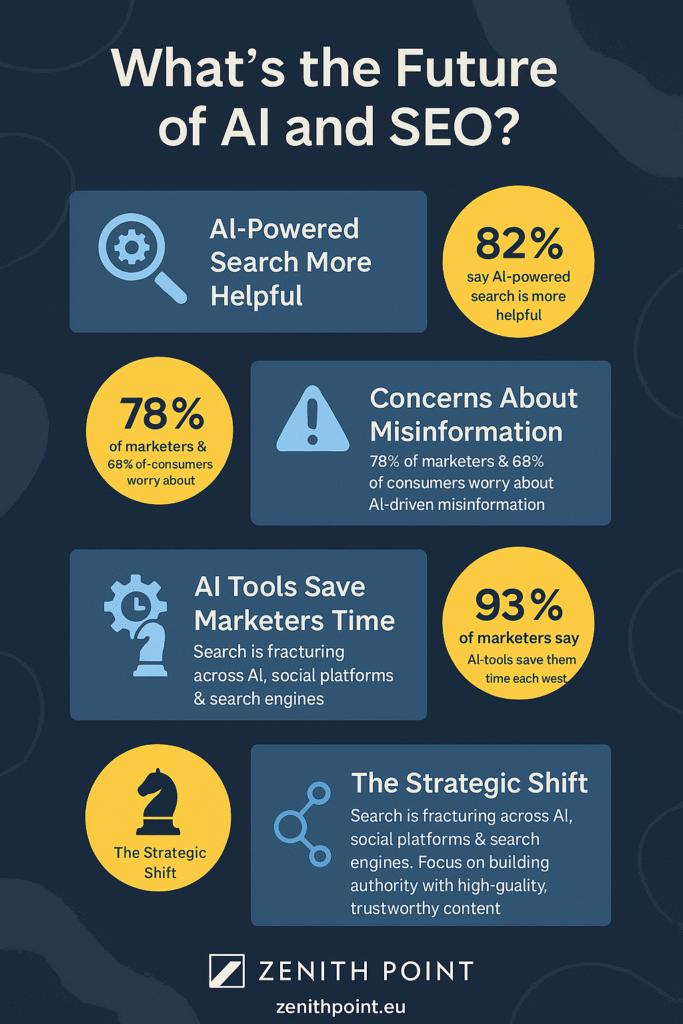
TL;DR AI isn’t killing SEO; it’s reshaping it. With tools like ChatGPT, Gemini, and Google’s AI Overviews changing how people search, brands need to focus on authority, originality, and structured content. To stay visible, companies must create trust-driven, multi-platform strategies. At Zenith Point, we help businesses future-proof SEO with AI-ready content strategies. Introduction Search has always moved fast, but AI is now accelerating the pace. With Google’s AI Overviews and conversational bots like ChatGPT providing instant answers, SEO is no longer just about ranking in the top 10. Instead, it’s about building content that fits AI-generated results and new search behaviors. Brands that adapt with trust-driven, authoritative strategies will stay competitive. Let’s explore the future of AI and SEO in 2025. The Rise of AI-Powered Search Behavior AI is Shifting How People Search Surveys show that two-thirds of shoppers expect AI to overtake traditional search in five years. Today, AI chatbots still drive only about 3% of search traffic, but that share is growing quickly. Users are frustrated by cluttered SERPs filled with ads. In contrast, AI-powered engines deliver fast, ad-free, conversational answers. Key Insight: 8 in 10 shoppers say AI-driven results are more useful than traditional SERPs. Search Is No Longer a Platform—It’s a Habit Whether users type into Google, ChatGPT, or TikTok, the act of searching is fluid. For SEO professionals, this means the winning strategy is creating trustworthy, high-quality content that works across all platforms. Opportunities and Challenges for Marketers Opportunities Challenges 👉 Learn more about this shift in the future of SEO with AI and recent analysis from Forbes and Search Engine Land. How to Future-Proof Your SEO Strategy Focus on Generative Engine Optimization (GEO) GEO ensures your content is ready for AI search engines by prioritizing: Build Authority Across Platforms Earn features in trusted outlets, cite experts, and build backlinks from credible sources. Authority is built through third-party validation. Embrace Proprietary Sources of Truth Feeding AI models with your own research, guides, and data reduces errors and builds brand trust. Create with Originality and Depth AI-assisted content that is unique, insightful, and well-structured performs better. Quality comes first, speed second. Develop Human-in-the-Loop Workflows Let AI handle first drafts, but always use human editors for fact-checking, tone, and brand alignment. Reinvest Time Savings Wisely Use AI’s time-saving power to experiment, teach, and strengthen brand culture rather than just increasing content volume. The New SEO Formula: Authority + Trust + Originality SEO is not dying—it’s evolving. Winning content in 2025 will live across: Instead of gaming algorithms, brands must focus on authentic authority, structured data, and user trust. FAQ: What Is the Future of AI and SEO? Will AI replace traditional search engines? Not entirely. AI will complement search engines, handling fast answers, while Google remains strong for deep research. Can AI-generated content rank on Google? Yes—if it is fresh, sourced, and edited. Google values E-E-A-T: Experience, Expertise, Authoritativeness, Trustworthiness. Should marketers worry about AI misinformation? Yes. The solution is to use closed data sources and human oversight to avoid errors. How should brands adapt SEO strategies? Build content strategies that combine: What skills should marketers invest in? Prompt writing, AI tool mastery, fact-checking, and performance tracking across AI and traditional search. How Zenith Point Digital Marketing Can Help At Zenith Point, we help businesses adapt to the evolving world of AI-driven SEO. Our services include: Explore our case studies to see how we’ve boosted visibility, traffic, and conversions for clients. Whether you need traditional SEO optimization or AI-ready strategies, Zenith Point ensures your brand stays ahead. Final Thoughts AI and SEO are not competing—they are merging. Success in 2025 depends on creating authoritative, trustworthy, and original content that works across search engines, AI tools, and social feeds. Brands that prioritize clarity over clutter and authority over shortcuts will win the digital race. 👉 Ready to future-proof your SEO? Contact Zenith Point today.

What Does AI Mean for SEO Tomorrow? Read More »

SaaS

A Step-by-Step Guide to Finding Your First 100 SaaS Beta Testers

TL;DR It’s not a happy accident to land your first 100 beta testers for your SaaS product. You will need to foster relationships, get to the right places, and give real value. For instance, begin with emails, get social, utilize beta platforms like Product Hunt or BetaList, blog or guest blog as a storytelling method, and approach micro-influencers in your space. You will need to iterate and become ever-faster in your execution. You should also treat all beta testers like business partners. In today’s world, many businesses do not know how to position and market their SaaS tool properly. Zenith Point can help. We will do smart digital marketing for you, and will position your SaaS tool properly. In this way, your beta testers will become long-term paying users. Who is a beta tester? A beta tester is someone who tries your SaaS product before you release it to the public. They do not only add value as users; instead, they collaboratively shape the product with you. Beta testers: People often call them your first 100 fans. With their input, your product becomes more refined and user-friendly. Step 1 for finding beta testers: Use emails effectively Email is one of the simplest ways to reach potential testers. If you’re building a landing page, use a persuasive headline like: “Claim your spot as the first tester of our new SaaS tool.” Step 2 for finding beta testers: Try social media Social platforms are powerful for connecting your SaaS product with early adopters. Share your progress and insights about building your product. Post updates such as: Use hashtags like #buildinpublic, #SaaS, #startup, and #SaaSideas to reach the right audience. Here are some of the incentives you can offer: Step 3 for finding beta testers: Use Product Hunt, Betalist, and other beta testing sites These platforms provide instant visibility and feedback: These sites bring motivated testers who are excited to try new SaaS products. Step 4 for finding beta testers: Blogging and guest posting Content is an excellent way to attract beta testers: For example, if your SaaS helps with project management, write: “5 Persistent Issues Teams Face When Managing Projects” and invite readers to test your product at the end. Zenith Point can support you with SEO-optimized content and backlinking strategies to make your blog posts reach the right audience. Step 5 for finding beta testers: Reach out to influencers Influencers and micro-creators can put your SaaS in front of the right audience. Influencers usually: Offer them: These partnerships not only bring in beta testers but also long-term customers. Learning from your beta testers Getting testers is just the beginning. The real value comes from listening to their feedback. Ask questions like: Collect feedback through: But if you’re not ready to invest in a tool, here are two other ways you can gather feedback: Early feedback helps you streamline onboarding and focus on features that matter most. Why do you need beta testers, and how do you find them? You need beta testers because they validate your product, highlight bugs, and spread awareness. Ways to find them: Start small, act on the feedback you receive, and build momentum from there. Frequently asked questions What is the role of a SaaS beta tester? A SaaS beta tester uses your product and shares feedback on bugs, usability, and features. They help you see if your service meets real needs. How many beta testers should I aim for? 100 is a strong goal. It’s enough to provide diverse feedback while still being manageable. Do beta testers pay for the SaaS? Not always. Many beta testers expect free access, but you can offer nominal fees if you communicate the value clearly. How long should a SaaS beta test last? Typically 4–8 weeks. This gives enough time for testers to use the product without burning out. Can Zenith Point help me find beta testers? Yes. Zenith Point uses social media marketing, technical SEO, and content creation to reach the right early adopters for your SaaS. What makes Zenith Point different? We focus on conversions. Our strategies combine web design, SEO, and content marketing to not only attract users but also turn them into long-term paying customers. How Zenith Point can help Zenith Point specializes in helping SaaS founders move from idea to traction. We can: It’s not just about visibility—we track engagement and retention to ensure beta testers stay active and turn into paying customers. Conclusion Getting your first 100 beta testers is about strategy, not luck. Here’s what to do: With the right approach—and support from Zenith Point—you won’t just gain beta testers. You’ll build the foundation of a loyal user community ready to grow with your SaaS. Further reading and resources:

A Step-by-Step Guide to Finding Your First 100 SaaS Beta Testers Read More »

23a4f88a 6a2e 4cd6 8b8b fc1f3b88ccd2

Who Can Fix My Technical SEO Mess?

On a practical level, technical SEO builds the scaffolding that lets search engines find and trust your website. Without a strong frame, even killer articles and tons of social shares gather dust in the basement. A site that drags on load speed, throws up crawl errors, or misfires with pointless redirects wounds itself before anyone even gets through the front door. The quick question, then, is who is going to wrench those bolts back into place?Let’s name a couple options and wrap the troubleshooting in plain English. Quick Take Web pages that vanish from search results or bleed traffic almost overnight often signal broken back-end bones. A sharp technical SEO consultant digs under the hood, spots the trouble, and makes sure Google can crawl, index, and show off the pages. Audits, crawl maps, Core Web Vitals tweaks, even a heavy-lifting migration; it is all on the menu. For granular drills, many pros point at Olga Zarr, whose reviews spotlight in-the-trench audits and quick fixes. Agencies such as Zenith Point Digital Marketing bundle similar work into project packages and help clients climb back after nasty traffic drops. Why Technical SEO Matters Technical SEO is basically the behind-the-scenes plumbing that keeps your website water-tight. If search engines can’t crawl or read your pages, you’ll notice some pretty nasty leaks: Nobody thinks about pipes until the bathroom ceiling drips. Who Can Help Me With Technical SEO? Finding a pro to handle the nitty-gritty is easier than you think. Most website owners either hire a freelance consultant or turn to an established SEO agency. Work with a Technical SEO Consultant Freelance pros often dig deep with one-on-one focus. Take Olga Zarr: she’s been fixing backend messes for 12 years and has steered giants like Procter & Gamble back on course. A visit to her site can kick off a conversation—or at least give you a solid benchmark. What Does a Technical SEO Consultant Do? A technical SEO consultant dives into the behind-the-scenes part of your site. They run full audits that check over 200 hidden boxes most folks never see. Some call it nose-to-tail analysis. Crawl and indexability checks follow. The goal is to see whether search engines can even find your pages. JavaScript tricks pop up next. Bugs in React or heavy-load scripts can hide content from crawlers. A consultant will also pick apart your structured data. Clean schema markup boosts snippets and rich results. Then they map redirects to banish 404 errors. Broken links waste link juice and annoy visitors. Core Web Vitals land high on the list, too. Fast, smooth experiences keep users—and Google—happy. Log file reads show how bots behave once out of sight. Those text files reveal unexpected crawl patterns. Sitemaps and robots.txt get a fine-tooth comb, as well. Misconfigurations keep good pages out of the loop. Canonical tags and hreflang pairs later catch duplicate and language drift. One wrong tag sows confusion across domains. People juggling complex hiccups often call Olga Zarr’s SEO Reality Check at $999. It pinpoints trouble and hands you an action plan. Hire an SEO Agency If your list skims wider territory—like content plans, link building, or local tweaks—an SEO agency might fit better. Agencies stack technical chops on top of editorial calendars and outreach teams. 🧩 Signs You Need Technical SEO Help Something feels off and you can’t shake it. If any of these signals land in your inbox or on your dashboard, calling for back-up isn’t a bad idea: ✅ How Zenith Point Digital Marketing Can Help Zenith Point Digital Marketing specializes in those sticky, nuts-and-bolts SEO headaches that no amount of keyword stuffing can cure. Whether you need a full-blown technical audit, a hand getting a wobbly migration back on its feet, or straight talk about boosting site speed and trimming the crawl budget, our crew has the tools and know-how. We work hands-on, letting the numbers shout first, then building fixes the data demand. The result is clearer visibility in search results and faster, smoother pages for your visitors. ❓ FAQ: Who Can Help Me With Technical SEO? How do I even find a technical SEO consultant?Think of the consultant as a website mechanic. They crawl under the hood, spot bottlenecks that keep search engines out, and tighten leaky settings that slow visibility. The end goal is simple: make sure algorithms and people can read, trust, and love your site. Do I Need Technical SEO If I Already Do On-Page SEO?Even your best on-page tweaks fall flat without a rock-solid tech foundation. A single broken link, a slow-loading page, or a crawl block can keep search engines from spotting your carefully chosen keywords. So yes, technical SEO is equally non-negotiable. Can a Developer Handle Technical SEO?Many developers speak fluent code, yet they don’t always juggle SEO rules and ranking signals. A dedicated technical SEO pro knows how to tweak server settings, manage redirects, and still keep performance humming. The skill set isn’t exactly interchangeable. What Tools Do Technical SEO Experts Use?Common weapons in the tech SEO’s toolbox include: Each tool shines in a different area, from spidering to site speed to raw server data. How Much Does Technical SEO Cost?Freelancers typically quote somewhere between $500 and $5,000+, depending on scope and urgency. For a deep-dive audit, consultant Olga Zarr’s SEO Reality Check is priced at $999. Corporate-level audits can easily climb into five-figure territory. Final Thoughts If solid links and killer content still leave your rankings gasping, the trouble may lurk beneath the surface. A sharp technical SEO audit can shine a flashlight under the hood and show you exactly what’s grinding the gears. Fixing those issues often delivers the fastest ranking lift of all. Picking a seasoned pro, say someone like Olga Zarr, or teaming up with a reliable outfit like Zenith Point Digital Marketing, can seriously boost your website’s long-term search power. When you tighten the technical nuts and bolts, your visibility tends to stay up. 👉 Short on time and need a technical tune-up? Contact Zenith

Who Can Fix My Technical SEO Mess? Read More »

69cdb344 fb80 4a32 87d3 827ac89a87e2

Which Digital Marketing Strategy Best Fits Your Business?

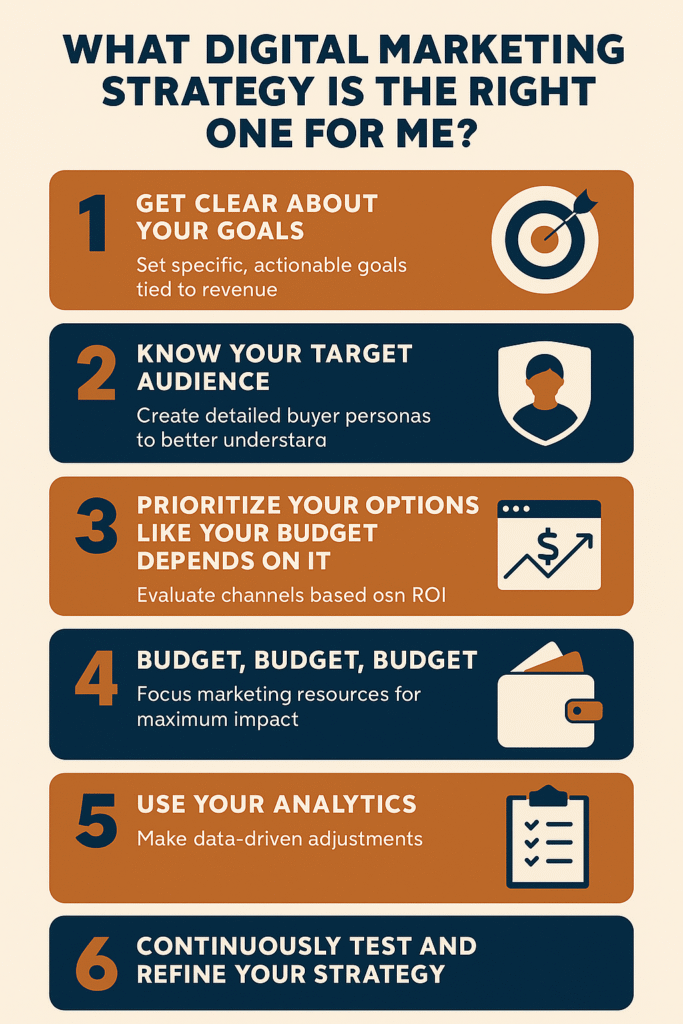
In this ever-evolving market, growing your business is no walk in the park. Selecting the correct digital marketing strategy is the first critical step. From paid advertising, SEO, and influencer campaigns, there’s no scarcity of digital marketing strategies and tools. The problem now becomes how to determine which strategy is ideally suited for your goals, audience, and niche. TL;DR Not every single business is suited for every single marketing strategy and that is perfectly alright. Ask yourself the right questions and the desired answer follows. What business goal do you wish to achieve? What is the existing competition? What SEO, social media, email, or even PPC markers best describe marketing for your brand? Craft your strategy in a manner that fixes customer hurdles and in return generates measurable results. At Zenith Point, we focus on tailoring business strategies to achieve high conversion rates. Why Selecting the Right Strategy is Important With 2025 just right around the corner, advancing brands into the digital landscape, many newer and existing brands are now investing in digital marketing as opposed to traditional marketing tools. However, many digital marketers still struggle when it comes to connecting their investment to returns. Hundreds of marketing masters are boosting their digital marketing spend. However, a lack of clarity paired with skill gaps as well as the emergence and widespread adaptive use of AI are hurdles for successful marketing campaigns. All of these factors are best summed up as doing more opposed to doing more of the right things, better. A digital marketing strategy goes beyond creating a list of tactics. It bridges your company goals to your audience’s needs using the most appropriate digital methods. Strategy vs. Tactics: Know the Difference Every step of the way requires a strategy. Here’s the differentiation: Your strategy answers: Your tactics could include: Your strategy sets the boundaries and your tactics execute it. How to Choose the Right Digital Marketing Strategy 1. Know Your Customer First Understanding the customer should always come first. If you are unaware of their profile, what their preferences are, and what platforms they are active on, whatever strategy you implement will yield limited results. Actions: 🎯 Pro tip: Google Analytics, Meta Insights, or customer feedback contain valuable clues to audience behavior. 2. Review What You’ve Done So Far Consider what’s already working before trying to create new systems. Audit steps: Strong content could go unnoticed if the right promotion isn’t in place. 3. Focus on Benefits, Not Features Modern consumers care about how a product improves their lives, not just specs. Example: 4. KPIs and Feedback Loops Your digital marketing shouldn’t be “set it and forget it.” Best practices: Best Digital Marketing Strategies and When to Use Them 📚 Content Marketing ➡️ Example: Salesforce+ launched a streaming platform dedicated to B2B thought leadership content. 🔍 Search Engine Optimization (SEO) Though slower to yield results, SEO drives consistent traffic without paying for every click. 📱 Social Media Marketing Use analytics to refine posting times and formats. 💰 Paid Advertising (PPC & Social Ads) High-quality, relevant ads are rewarded with lower CPC. 🤝 Influencer Marketing ➡️ Example: Absolut vodka aligned with eco and LGBTQ+ influencers, generating over 68M impressions. ✉️ Email Marketing Email marketing remains one of the best ROI channels. ➡️ Example: Adidas uses AI-powered personalization to boost engagement and conversions. What’s Right for You? Here’s a quick cheat sheet: Your Goal Best Strategy Brand awareness development Social Media + Content Marketing Generate leads SEO + Email Marketing Immediate sales Paid Advertising (PPC) Brand credibility Influencer + Content Marketing Long-term growth SEO + Content + Email Marketing Start small, focus on what aligns with your strengths, and scale what works. Frequently Asked Questions ❓ Can I just focus on one strategy? You can, but most companies see better results by combining strategies—like content supporting SEO and email. ❓ How long before I see results? Paid ads show quick wins. SEO and content usually take 3–6 months to show significant results. ❓ Is social media still worth it? Yes, but success requires platform-specific strategies and community-building, not just broadcasting. ❓ What’s the most cost-effective strategy for small businesses? Small businesses often see the best ROI from SEO and email marketing. Social media and content can also work if done in-house. How Zenith Point Can Help You Choose the Right Strategy At Zenith Point, we don’t believe in copy-paste strategies. Every business is unique. Our approach is designed to: ✅ Identify your true audience✅ Align digital channels with business goals✅ Build strategies with real data, not guesswork✅ Continuously optimize performance Need to refine your SEO, launch paid ads, or scale your content marketing? We’ve got the expertise and tools for meaningful growth. 👉 Let’s put your perfect strategy in place. Additional Resources

Which Digital Marketing Strategy Best Fits Your Business? Read More »

c0918f2c a8d2 46db 8701 cb038ccbc3ca

How to Pick the Correct Digital Marketing Strategy

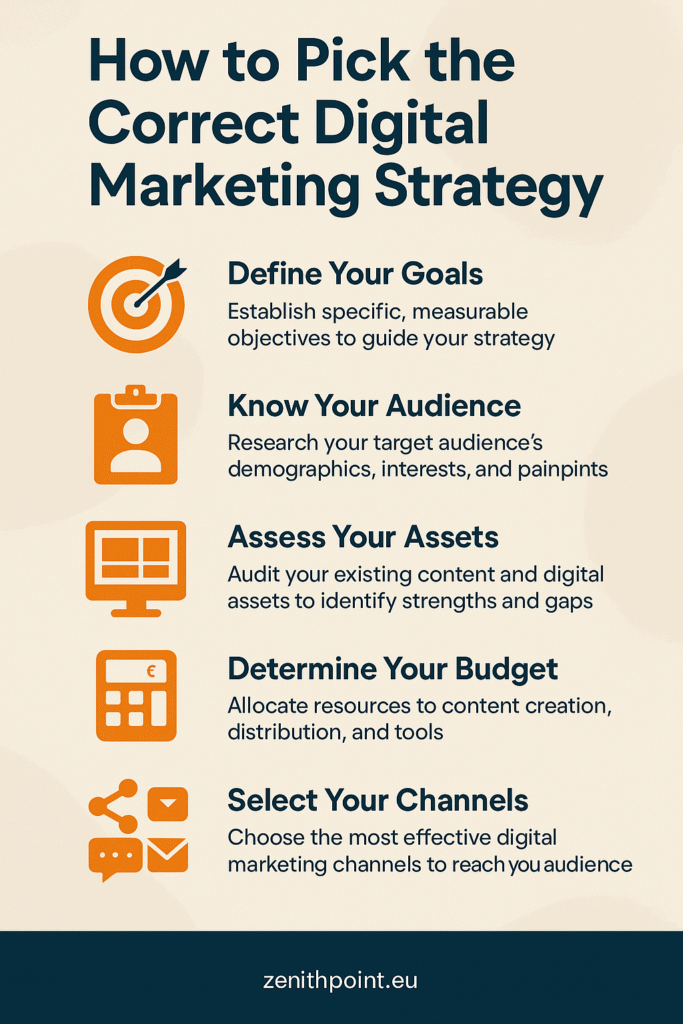
How to Choose the Right Digital Marketing Strategy In the contemporary online arena, selecting a digital marketing strategy has evolved from being optional to a necessity. Customers expect visibility and engagement, and businesses face countless tools, platforms, and channels. This makes deciding on the right approach to achieve meaningful results complex. If you are a startup founder, a Chief Marketing Officer (CMO), or a marketing manager, the first step to achieving long-term growth is aligning your digital strategy with business objectives. This guide explains how to pick the best marketing strategy for your brand to transform clicks into customers. TL;DR Every business is unique, and selecting the correct digital marketing strategy means defining SMART goals, knowing your audience, auditing your assets, setting budgets, and choosing the most effective marketing levers. A strong strategy provides clarity, alignment, and measurable results. For more guidance, review Business.com’s article on choosing a strategy and Strategy+Business insights. 1. Set SMART Goals Every digital marketing strategy should align with business objectives through SMART criteria: When campaigns are designed with SMART KPIs, businesses increase ROI by encouraging productivity and accountability. For instance, setting a goal of a 25% increase in qualified leads within 6 months provides a clear benchmark for success. 2. Audience Research Digital trends continue to reshape shopping patterns and customer expectations. Every company has an ideal customer that should guide strategy implementation. Build Buyer Personas When creating personas, consider: For example, if your customer is a mid-level IT manager in Europe who prefers technical content, you should prioritize long-form articles, email newsletters, and LinkedIn outreach. 3. Content Audit A content audit evaluates the effectiveness of your existing digital assets and identifies opportunities for improvement. Benefits of a Content Audit Conducting a full site crawl using tools like Screaming Frog or SEMrush reveals both strengths and weaknesses. You may discover high-value content worth expanding, or gaps requiring a technical SEO audit. 4. Choose Your Budget No strategy succeeds without a realistic budget. Key considerations include: Ad budgets provide measurable parameters to evaluate ROI. For limited budgets, focus on strategies like SEO and content marketing, which deliver long-term value. For product launches or urgent campaigns, invest in PPC and social ads for immediate traction. 5. Select Your Marketing Levers Marketing levers are chosen based on goals and audience accessibility. Each lever offers unique strengths. Common Digital Levers SEO (Search Engine Optimization) Best for long-term visibility and organic traffic. Focus on technical fixes, keyword research, and optimized content. Content Marketing Blogs, guides, videos, and whitepapers educate and convert audiences while building authority. Social Media Marketing Effective for awareness and engagement. Select platforms strategically: LinkedIn for B2B, Instagram or TikTok for B2C. Email Marketing Delivers personalized, targeted communication to nurture leads and boost retention. PPC & Paid Social Perfect for quick visibility during product launches, promotions, or retargeting campaigns. Video Marketing Creates strong connections through storytelling, testimonials, and demonstrations. AI Tools & Chatbots Enhance customer experience and lead qualification through real-time support and automation. Why a Digital Strategy Matters A digital strategy ensures your business avoids fragmented efforts and instead focuses on long-term objectives. It answers: A strategy bridges overarching business goals with actionable marketing plans. For deeper insights, explore Adobe’s overview of digital strategies. Example of SMART Strategy in Action Target: Revive the stagnant customer base for home automation appliances by 30% within Q2.Strategy: Promote upgrades from legacy models to smart appliances.Execution: Publish case studies, run email campaigns, and launch LinkedIn ads. This plan aligns with SMART principles—specific, measurable, attainable, relevant, and time-bound. How Strategy, Campaigns, and Tactics Work Together Level Purpose Example Strategy Long-term plan aligned with goals Build authority in the SaaS market Campaign Medium-term initiative with focus Launch a whitepaper series targeting CTOs Tactic Specific action within a campaign Publish and promote LinkedIn blog teasers Each layer builds on the other, ensuring cohesive execution. Measuring Success with KPIs Select KPIs tied to goals and channels. Examples include: Tracking KPIs allows businesses to refine campaigns and respond to evolving trends. FAQ: How to Select the Right Digital Marketing Strategy What is a digital marketing strategy? It’s a long-term plan aligned with business goals that uses digital channels like SEO, social media, email, and paid ads. How do I identify the right channels? Choose based on goals, audience insights, and budget. Data-driven personas guide this process. Should I focus on organic or paid marketing? Both have benefits. SEO builds long-term trust, while PPC delivers immediate visibility. Many businesses combine both. Can strategies change over time? Yes. Regular performance reviews ensure your strategy evolves with shifting customer needs and business objectives. How Zenith Point Can Help You Succeed At Zenith Point, we design custom strategies—not cookie-cutter solutions. From technical SEO audits to content planning and cross-channel campaigns, our focus is on clarity, execution, and measurable growth. Ready to unlock your potential? Contact us today to start building your digital success story. Visit: https://zenithpoint.eu “`

How to Pick the Correct Digital Marketing Strategy Read More »

Screenshot 5

Case Study: How Zenith Point Scaled a SaaS Startup’s Growth with Digital Marketing

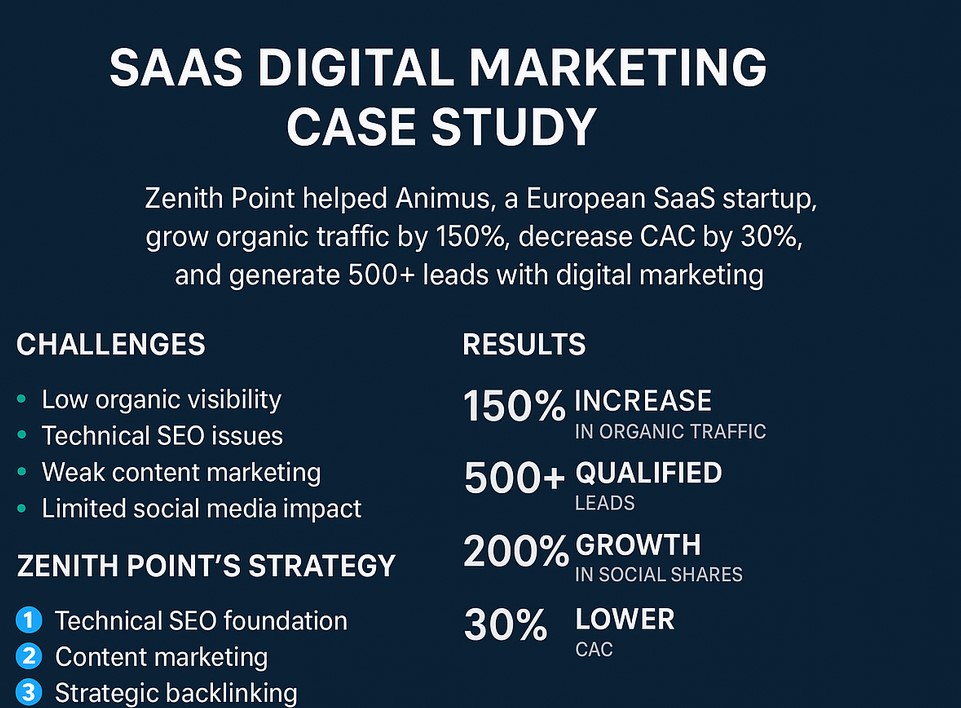
Client names remain undisclosed due to NDA. TL:DR Within half a year Zenith Point helped Animus, a SaaS project management tool startup, with a growth stuns. Even with a product competitive enough to gain and retain customers, it still struggled with visibility, organic traffic, and cost-effective customer acquisition. In Analytics Zenith Point tracked success from strategy & tactics within technical SEO, SEO-optimized content, social media marketing, backlinking, and cross-platform content syndication. Introduction The sheer thought of launching capital and fame raising SaaS startup seems to be a deep abyss. But for those who have tried their hands at it, the reality can be a lot grimmer. This was the case with Animus, a B2B Europe SaaS project management tool LLC. Most folks featured on the SaaS subreddit claim to know the pain of a product with value but no real means of marketing, paired with developers who can scale but know marketing lingo as well as a toddler knows their alphabet, and the resulting growth stagnation paid to the low organic traffic. This is where Zenith Point enters the frame, with deep digital marketing tailored for SaaS and content building for SEO. This brief tells how we assisted Animus fuel their growth big time while still being frugal; a dream that many SaaS entrepreneurs seem to have according to Reddit threads. The Client: Animus (Anonymized) What does Animus do? Animus created a lightweight, easily automatable SaaS project management system aimed at small and medium B2B teams throughout Europe. They presented a new approach by providing an assistive, intelligent workflow engine that automates primary task repetition in project management. Buyer Persona Fit Their ideal users were aligned with r/SaaS-type founders and executives: The Challenges Animus had an exceptional product but still was a victim to the common SaaS growth obstacles: 1. Low Organic Visibility Most efforts were directed to cold communication and PPC advertisements. With the capitalization that was in place, CAC was not manageable. 2. Technical SEO Problems 3. Lackluster Content Marketing Animus held a blog, but it was more product-centered when it should have been more customer-centered. Very few articles attempted to solve a buyer’s frustration, like “how to reduce churn in SaaS teams” or “how to use automation in project management.” 4. Absence of a Backlinking Plan The domain authority was lower, making it more difficult to rank for the more competitive terms in the SaaS-related searches. 5. Minimal Impact from Social Media Marketing Their social accounts resembled product announcement pages more than anything, and the lack of engagement was appalling. Zenith Point’s Strategy The Zenith Point team built a bespoke digital marketing strategy with four main pillars: 1. The Foundations of Technical SEO 👉 Read more about Technical SEO. 2. Buyer Persona Focused Content Marketing We transformed Animus’s blog from featuring updates to telling stories about the solutions: 👉 Explore SEO-optimized content. 3. Backlink Acquisition 👉 Learn more about Backlinking strategies. 4. Social Media Overhaul 👉 See our Social Media Marketing approach. The Results After 6 months of collaboration, Animus achieved transformational growth. SEO & Marketing Strategy MQL Funnel Company Value Social Engagement Feedback From SaaS Founders Like many founders in the SaaS community, SaaS founders: The compelling evidence for Animus was the case that the results were ROI driven and budget friendly. We also decreased CAC while measuring MRR growth for true value. This speaks directly towards the mindset of the SaaS founders who want to see: Zenith Point managed to get qualified users that converted which meant that the users that were provided were not just plain traffic. Client Feedback “We finally feel like growth is under control.” FAQ: Positive Results for SaaS Growth Q1: How measurable did results become and in what time frame?Between the first and second month, there were measurable SEO improvements and then between the third and sixth month, there was significant lead growth. Q2: What was the ROI that Animus managed to achieve?Within the first six months, ROI was achieved successfully and what helped was reducing customer acquisition cost by 30% and then Animus was able to double the trial to paid conversion rate. Q3: How did organic traffic compare to paid ads?Organic referrals were the most significant component and as a result, there was a decrease in reliance to paid ads. Q4: Is this growth method adaptable to other SaaS, how scalable is this approach for other SaaS startups?It is meant for scalability. Startups can begin with just a simple blog and then advance to backlinks and social ads once there is proof of ROI. Q5: What metrics should be prioritized by founders of a SaaS business and why?We narrowed it down to CAC, LTV, growth in MRR, and conversions rate and ignored the so-called ‘vanity metrics’ like impressions and page views. Conclusion This case study outlines how Zenith Point assisted B2B SaaS startup Animus in resolving the challenges they faced during the growth phase by enabling sustainable scaling. Focusing on the SaaS founders’ relentless pain points — high CAC, low organic traffic, and poor visibility — we designed a marketing system that produced optimal results in under 6 months. If you are a SaaS founder anxious to grow the business without a cash burn, let us help you on your journey toward growth at Zenith Point. 👉 Want to grow like Animus? Contact Zenith Point today. 📌 Explore more case studies📌 Review our SEO pricing models for 2025📌 Learn about Generative Engine Optimization📌 Check our Web Design services

Case Study: How Zenith Point Scaled a SaaS Startup’s Growth with Digital Marketing Read More »