
TL;DR
AI isn’t killing SEO; it’s reshaping it. With tools like ChatGPT, Gemini, and Google’s AI Overviews changing how people search, brands need to focus on authority, originality, and structured content. To stay visible, companies must create trust-driven, multi-platform strategies. At Zenith Point, we help businesses future-proof SEO with AI-ready content strategies.
Introduction
Search has always moved fast, but AI is now accelerating the pace. With Google’s AI Overviews and conversational bots like ChatGPT providing instant answers, SEO is no longer just about ranking in the top 10. Instead, it’s about building content that fits AI-generated results and new search behaviors.
Brands that adapt with trust-driven, authoritative strategies will stay competitive. Let’s explore the future of AI and SEO in 2025.
The Rise of AI-Powered Search Behavior
AI is Shifting How People Search
Surveys show that two-thirds of shoppers expect AI to overtake traditional search in five years. Today, AI chatbots still drive only about 3% of search traffic, but that share is growing quickly.
Users are frustrated by cluttered SERPs filled with ads. In contrast, AI-powered engines deliver fast, ad-free, conversational answers.
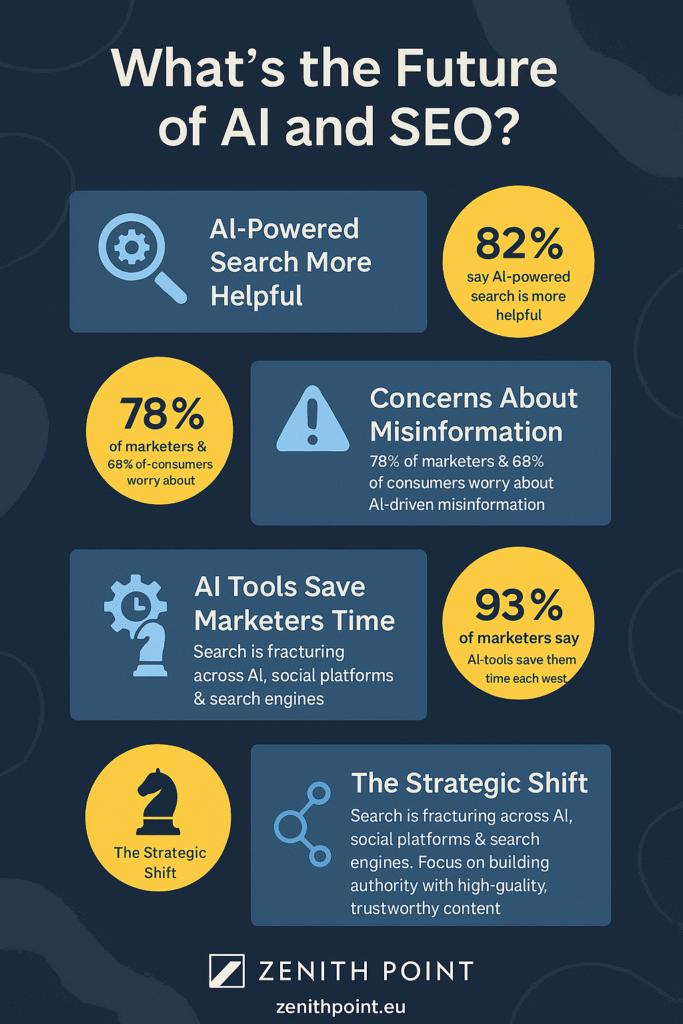
Key Insight: 8 in 10 shoppers say AI-driven results are more useful than traditional SERPs.
Search Is No Longer a Platform—It’s a Habit
Whether users type into Google, ChatGPT, or TikTok, the act of searching is fluid. For SEO professionals, this means the winning strategy is creating trustworthy, high-quality content that works across all platforms.
Opportunities and Challenges for Marketers
Opportunities
- 74% of marketers already use AI for at least one task.
- 93% say AI tools save real time.
- AI now helps create social posts, run SEO checks, and analyze data reports at scale.
Challenges
- 78% of marketers and 68% of customers worry about AI misinformation.
- Only 22% track visibility in large language models.
- Over half feel pressure to adopt AI, yet just 11% say they rely too heavily on it.
👉 Learn more about this shift in the future of SEO with AI and recent analysis from Forbes and Search Engine Land.
How to Future-Proof Your SEO Strategy
Focus on Generative Engine Optimization (GEO)
GEO ensures your content is ready for AI search engines by prioritizing:
- Clean, structured content.
- Entity authority supported by citations.
- Schema markup and transparent author bios.
- Fresh, first-party research that adds unique value.
Build Authority Across Platforms
Earn features in trusted outlets, cite experts, and build backlinks from credible sources. Authority is built through third-party validation.
Embrace Proprietary Sources of Truth
Feeding AI models with your own research, guides, and data reduces errors and builds brand trust.
Create with Originality and Depth
AI-assisted content that is unique, insightful, and well-structured performs better. Quality comes first, speed second.
Develop Human-in-the-Loop Workflows
Let AI handle first drafts, but always use human editors for fact-checking, tone, and brand alignment.
Reinvest Time Savings Wisely
Use AI’s time-saving power to experiment, teach, and strengthen brand culture rather than just increasing content volume.
The New SEO Formula: Authority + Trust + Originality
SEO is not dying—it’s evolving. Winning content in 2025 will live across:
- Google Search (traditional SERPs).
- AI Engines like ChatGPT, Gemini, and Perplexity.
- Social Platforms like TikTok and Instagram Reels.
Instead of gaming algorithms, brands must focus on authentic authority, structured data, and user trust.
FAQ: What Is the Future of AI and SEO?
Will AI replace traditional search engines?
Not entirely. AI will complement search engines, handling fast answers, while Google remains strong for deep research.
Can AI-generated content rank on Google?
Yes—if it is fresh, sourced, and edited. Google values E-E-A-T: Experience, Expertise, Authoritativeness, Trustworthiness.
Should marketers worry about AI misinformation?
Yes. The solution is to use closed data sources and human oversight to avoid errors.
How should brands adapt SEO strategies?
Build content strategies that combine:
- Optimized web pages.
- Strong authority signals.
- Cross-platform visibility.
- AI-focused keyword research.
What skills should marketers invest in?
Prompt writing, AI tool mastery, fact-checking, and performance tracking across AI and traditional search.
How Zenith Point Digital Marketing Can Help
At Zenith Point, we help businesses adapt to the evolving world of AI-driven SEO. Our services include:
- Advanced keyword research with AI search intent in mind.
- Building SEO-optimized content that performs on both Google and AI platforms.
- Creating authority with backlinks, case studies, and first-party research.
- Blending AI-driven workflows with human creativity for maximum ROI.
Explore our case studies to see how we’ve boosted visibility, traffic, and conversions for clients.
Whether you need traditional SEO optimization or AI-ready strategies, Zenith Point ensures your brand stays ahead.
Final Thoughts
AI and SEO are not competing—they are merging. Success in 2025 depends on creating authoritative, trustworthy, and original content that works across search engines, AI tools, and social feeds.
Brands that prioritize clarity over clutter and authority over shortcuts will win the digital race.
👉 Ready to future-proof your SEO? Contact Zenith Point today.