
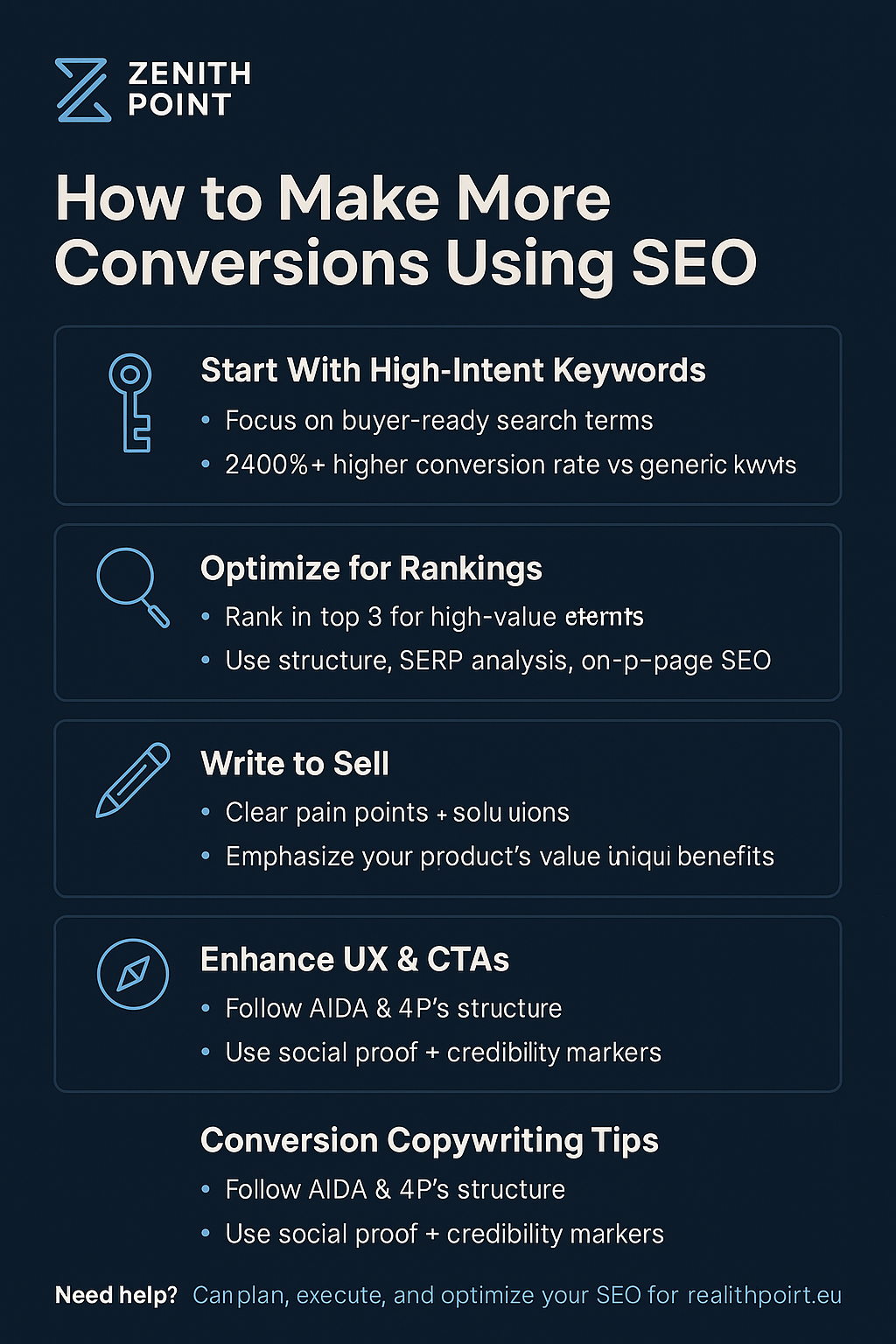
Search engine optimization or SEO is meant to garner attention on your website. But what happens after the click? If the traffic does not translate into any sales, leads or signups, the issue is not with traffic. You have a conversion problem instead.
In this guide, we will illustrate how to turn organic traffic into meaningful results with effective conversion rate optimization (CRO) strategies that align with SEO. Be it B2B, eCommerce, or a niche blog, these tactics will prove useful towards maximizing the ROI on your SEO investments.
TL;DR
- SEO builds traffic and incurs costs while conversion rate optimization (CRO) pays for itself by increasing leads, signups or sales.
- Understand user intent alongside with the sales funnel stage.
- Design pages around a primary conversion goal and a clearly defined secondary ask.
- Utilize calls-to-action (CTAs) at multiple points throughout the copy.
- Write and title content aligned with audience’s intent.
- Apply effective copywriting principles, such as AIDA, and the 4 Ps framework.
- Invest in social proof and case studies to effectively build trust.
- Employ full funnel growth strategies by merging SEO and CRO.
Why Your SEO Isn’t Converting (Yet)
Achieving a strong ranking on Google is just the beginning. Driving users to your website is only half of the journey—your content should make them take mutually beneficial actions too.
If you have a good amount of traffic but low conversion rates, it means your website is missing essential features that take potential customers from mere interest to actual commitment.
Conversion Rate Optimization: The Key to Unlocking SEO ROI
Maximizing the gain from SEO investments requires making the most of Conversion Rate Optimization (CRO), which is done by making changes to web pages so that users are better directed toward important actions, such as form submission and sign-ups.
Step-by-Step: How to Convert More Visitors with SEO
🔍 Step 1: Define What a Conversion Looks Like for You
Conversion can be defined differently by different businesses. Let’s have a look:
- B2B: Contact form submissions, demo requests, whitepaper downloads
- eCommerce: Add to cart, purchase, newsletter signup
- Content sites: Email subscriptions, affiliate clicks, time on site
Make sure that each page has a specific conversion goal and purpose.
🧠 Step 2: Understand User Intent & Funnel Position
Not every user is going to be ready to make a purchase, which is why it is essential to match your SEO content with the sales funnel level and user intent.
Consider the following questions:
- What is the user attempting to achieve with this search?
- Which stage of the funnel are they: awareness, consideration, or decision?
- What’s the best conversion ask for their current stage?
- What’s your goal for the page?
By user intent alignment with conversion asks, users are retained and guided within your funnel.
🎯 Step 3: Construct Pages Primed For Conversion
Each page should be SEO optimized and include:
✅ A Primary CTA
Your #1 ask—demo, quote request, or purchase.
🪜 A Secondary CTA
For visitors not ready to convert:
- Sign up for the newsletter
- Resource download
- Register for a webinar
- View a case study
- Access product comparison page
💬 Step 4: Strong Calls-To-Action (CTAs)
CTAs should be:
- Noticeable: Top, middle, and bottom of page
- Clear: Use active phrases like “Download the Guide” or “Get My Free Demo”
- Relevant: Align with user intent and provide value
Ask yourself:
- What’s the readers goals?
- What’s the benefit for them?
- Where is the destination?
- What validates your credibility?
📝 Step 5: Clickable Titles
Page titles are often the first impression. They should convey clear benefits and align with search intent.
Effective SEO Title Examples:
- How-To: Improve Donor Retention with Simple Email Sequences
- Why: Why Nonprofits Struggle with Planned Giving (And How to Fix It)
- Lists: 7 B2B Website Conversion Hacks
- Best: The 10 Best Fundraising Platforms In 2025
Apply the “so what?” test on each title: does the title explain why a user would care?
✍️ Step 6: Incorporate Copywriting That Drives Conversions
AIDA Model:
- Attention – Capture interest
- Interest – Speak to problems
- Desire – Show a better alternative
- Action – Encourage the reader to proceed
4 Ps:
- Promise – What’s in it for them?
- Picture – Explain the outcome
- Proof – Trust, testimonials, results
- Push – Compelling call to action
👥 Step 7: Add Social Proof To Build Trust
Bottom of the funnel pages tend to need more validation.
Add:
- Testimonials
- Case studies
- Statistics
- Oblique signals like “1,000+ professionals have joined…”
This builds trust and lowers mental barriers to action in the decision stage.
SEO + CRO Real-Life Results
Combining your SEO and CRO strategies yields powerful results.
Notable achievements from Nexus Marketing are:
- Significant increase in organic leads by 10X
- 266% Year on Year growth in qualified leads
- Over 100% improvement in bottom-funnel conversions.
How Zenith Point Digital Marketing Can Help
At Zenith Point, results matter the most. We ensure that our clients’ business needs are met by incorporating:
- Technical and content-driven SEO strategies
- Smart conversion copywriting
- Data-backed CRO recommendations
Whether the goal is to increase traffic, get more leads, sales, or subscribers, we are here to guarantee that SEO traffic translates to profitable returns.
Let’s talk if you are looking to optimize geography based SEO for conversions.
FAQ: Generative Engine Optimization
❓What is generative engine optimization?
Generative Engine Optimization is adjusting content for AI-driven searches, like ChatGPT, Gemini, and Perplexity, which do not link directly but combine multiple sources for answers.
❓How is GEO different from traditional SEO?
Traditional SEO focuses on Google’s algorithm and SERPs. GEO centers around AI-generated answers using structured, credible, and authoritative content.
❓How can I optimize for generative engines?
- Use clear formatting like H1s, bullet points, and short paragraphs
- Build authoritative topical clusters
- Include factual, well-cited data
- Anticipate searches framed as questions
❓ Is GEO the same as SEO?
Not really. GEO works alongside SEO. To ensure your content is effective for both human and intelligent search systems, you should consider future-proofing it.
Final Thoughts
Traffic is gained through SEO, while revenue is generated through CRO.
Businesses can see better results from organic traffic by understanding audience intent, smart CTAs, effective conversion copywriting, and trust-building through social proof.
Even the sharpest changes to a strong CTA, or more aligned titles and better headlines can have greater impacts.
Ready To Start? Make every page serve a purpose, every click count.
Want insights like this? Zenith Point Digital Marketing can be followed on Medium, and subscribing to the newsletter will deliver SEO and CRO tips directly to your inbox.