
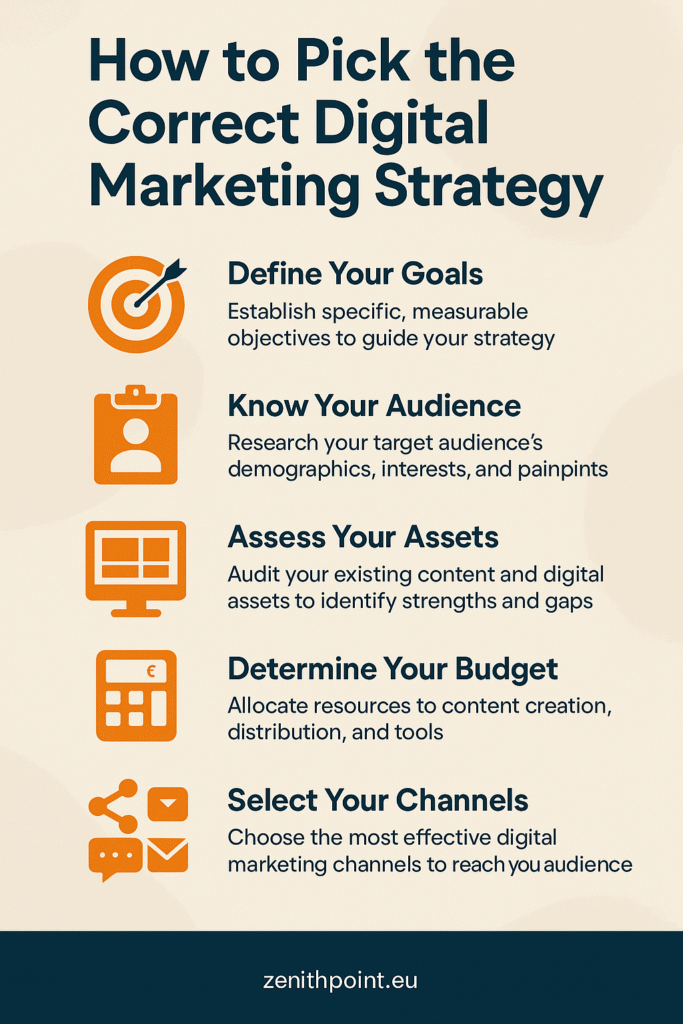
How to Choose the Right Digital Marketing Strategy
In the contemporary online arena, selecting a digital marketing strategy has evolved from being optional to a necessity. Customers expect visibility and engagement, and businesses face countless tools, platforms, and channels. This makes deciding on the right approach to achieve meaningful results complex.
If you are a startup founder, a Chief Marketing Officer (CMO), or a marketing manager, the first step to achieving long-term growth is aligning your digital strategy with business objectives. This guide explains how to pick the best marketing strategy for your brand to transform clicks into customers.
TL;DR
Every business is unique, and selecting the correct digital marketing strategy means defining SMART goals, knowing your audience, auditing your assets, setting budgets, and choosing the most effective marketing levers. A strong strategy provides clarity, alignment, and measurable results.
For more guidance, review Business.com’s article on choosing a strategy and Strategy+Business insights.
1. Set SMART Goals
Every digital marketing strategy should align with business objectives through SMART criteria:
- Specific
- Measurable
- Achievable
- Relevant
- Time-bound
When campaigns are designed with SMART KPIs, businesses increase ROI by encouraging productivity and accountability. For instance, setting a goal of a 25% increase in qualified leads within 6 months provides a clear benchmark for success.
2. Audience Research
Digital trends continue to reshape shopping patterns and customer expectations. Every company has an ideal customer that should guide strategy implementation.
Build Buyer Personas
When creating personas, consider:
- Age, education, and occupation
- Geographic location
- Income and lifestyle
- Interests, hobbies, and online behavior
For example, if your customer is a mid-level IT manager in Europe who prefers technical content, you should prioritize long-form articles, email newsletters, and LinkedIn outreach.
3. Content Audit
A content audit evaluates the effectiveness of your existing digital assets and identifies opportunities for improvement.
Benefits of a Content Audit
- Achieve business goals faster
- Strengthen your competitive edge
- Evaluate current campaigns for performance gaps
- Provide actionable recommendations for improvement
- Enhance strategies to target prospective customers
Conducting a full site crawl using tools like Screaming Frog or SEMrush reveals both strengths and weaknesses. You may discover high-value content worth expanding, or gaps requiring a technical SEO audit.
4. Choose Your Budget
No strategy succeeds without a realistic budget. Key considerations include:
- Campaign ad spend
- Tools and platforms
- Content production costs
- Paid vs. organic allocation
Ad budgets provide measurable parameters to evaluate ROI. For limited budgets, focus on strategies like SEO and content marketing, which deliver long-term value. For product launches or urgent campaigns, invest in PPC and social ads for immediate traction.
5. Select Your Marketing Levers
Marketing levers are chosen based on goals and audience accessibility. Each lever offers unique strengths.
Common Digital Levers
SEO (Search Engine Optimization)
Best for long-term visibility and organic traffic. Focus on technical fixes, keyword research, and optimized content.
Content Marketing
Blogs, guides, videos, and whitepapers educate and convert audiences while building authority.
Social Media Marketing
Effective for awareness and engagement. Select platforms strategically: LinkedIn for B2B, Instagram or TikTok for B2C.
Email Marketing
Delivers personalized, targeted communication to nurture leads and boost retention.
PPC & Paid Social
Perfect for quick visibility during product launches, promotions, or retargeting campaigns.
Video Marketing
Creates strong connections through storytelling, testimonials, and demonstrations.
AI Tools & Chatbots
Enhance customer experience and lead qualification through real-time support and automation.
Why a Digital Strategy Matters
A digital strategy ensures your business avoids fragmented efforts and instead focuses on long-term objectives. It answers:
- What goals are we aiming to achieve?
- What message do we want to convey?
- Who is our intended audience?
- How will we measure success?
A strategy bridges overarching business goals with actionable marketing plans. For deeper insights, explore Adobe’s overview of digital strategies.
Example of SMART Strategy in Action
Target: Revive the stagnant customer base for home automation appliances by 30% within Q2.
Strategy: Promote upgrades from legacy models to smart appliances.
Execution: Publish case studies, run email campaigns, and launch LinkedIn ads.
This plan aligns with SMART principles—specific, measurable, attainable, relevant, and time-bound.
How Strategy, Campaigns, and Tactics Work Together
| Level | Purpose | Example |
|---|---|---|
| Strategy | Long-term plan aligned with goals | Build authority in the SaaS market |
| Campaign | Medium-term initiative with focus | Launch a whitepaper series targeting CTOs |
| Tactic | Specific action within a campaign | Publish and promote LinkedIn blog teasers |
Each layer builds on the other, ensuring cohesive execution.
Measuring Success with KPIs
Select KPIs tied to goals and channels. Examples include:
- Organic traffic growth
- Conversion rates
- Cost per lead (CPL)
- Click-through rates (CTR)
- Sales qualified leads (SQLs)
- Customer lifetime value (CLTV)
Tracking KPIs allows businesses to refine campaigns and respond to evolving trends.
FAQ: How to Select the Right Digital Marketing Strategy
What is a digital marketing strategy?
It’s a long-term plan aligned with business goals that uses digital channels like SEO, social media, email, and paid ads.
How do I identify the right channels?
Choose based on goals, audience insights, and budget. Data-driven personas guide this process.
Should I focus on organic or paid marketing?
Both have benefits. SEO builds long-term trust, while PPC delivers immediate visibility. Many businesses combine both.
Can strategies change over time?
Yes. Regular performance reviews ensure your strategy evolves with shifting customer needs and business objectives.
How Zenith Point Can Help You Succeed
At Zenith Point, we design custom strategies—not cookie-cutter solutions. From technical SEO audits to content planning and cross-channel campaigns, our focus is on clarity, execution, and measurable growth.
Ready to unlock your potential? Contact us today to start building your digital success story.
Visit: https://zenithpoint.eu “`