
Search Engine Marketing (SEM) is one of the most effective strategies for engaging with potential customers right when they require your services, especially in a digitally dominated world with cutthroat visibility competition. Grabbing the attention of your audience—whether you are a new business trying to introduce a product to the market, or an established brand looking for new areas of growth—is possible with an understanding of how SEM operates and its strategies for providing a competitive edge in driving business growth and brand success.
This guide will cover the specific and fundamental components of SEM, its various types of campaigns, and provide you with actionable insights for measuring your success.
TL;DR
SEM, or Search Engine Marketing in its full form, is a form of marketing paid for by the business to appear in the results of an online search. It entails advertising on Google and paying for targeted ads and keywords associated with the business. It is fast—PPC SEM is the fastest way to gain results and is best for capturing an audience with a high likelihood of conversion. SEM is a comprehensive service encapsulating search, display, video, app, shopping, and local service ads.
What is Search Engine Marketing
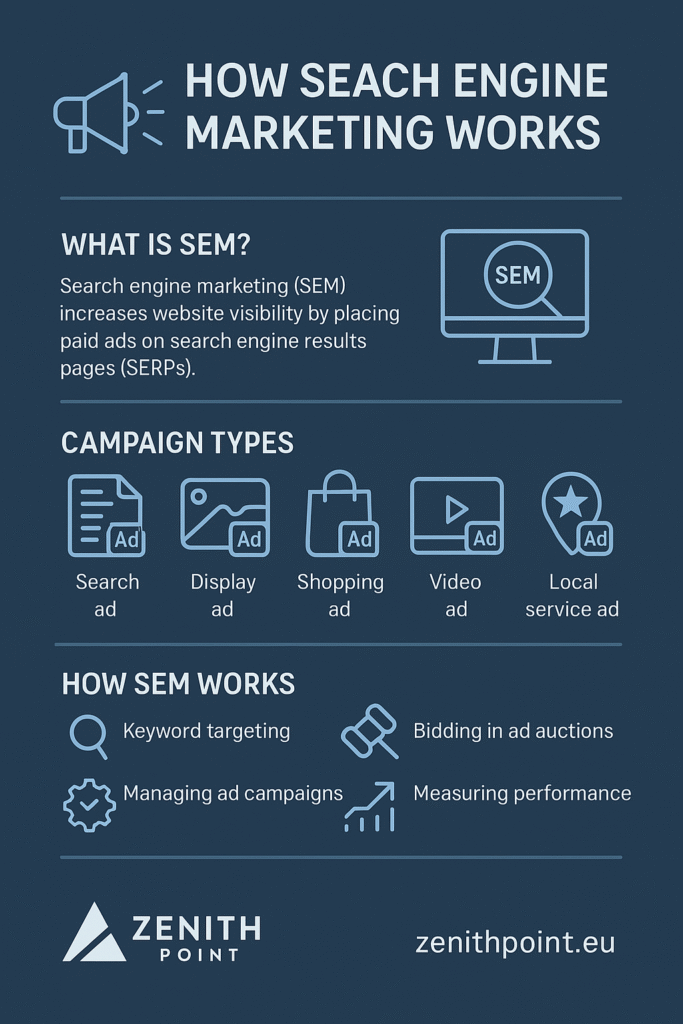
To promote a website, visibility in search results is one of the most critical areas of focus, and SEM is a widely adopted paid advertising model intended for this purpose. This model is intended to raise the visibility of a website in the Search Engine Results Pages (SERPs) with sponsored advertising. This is widely referred to as PPC (Pay-Per-Click) advertising because of its click-based payment model.
While Search Engine Optimization (SEO) is focused on organic ranking, SEM provides immediate visibility through ads. That said, both strategies rely heavily on keyword targeting and user intent.
How Does SEM Actually Work?
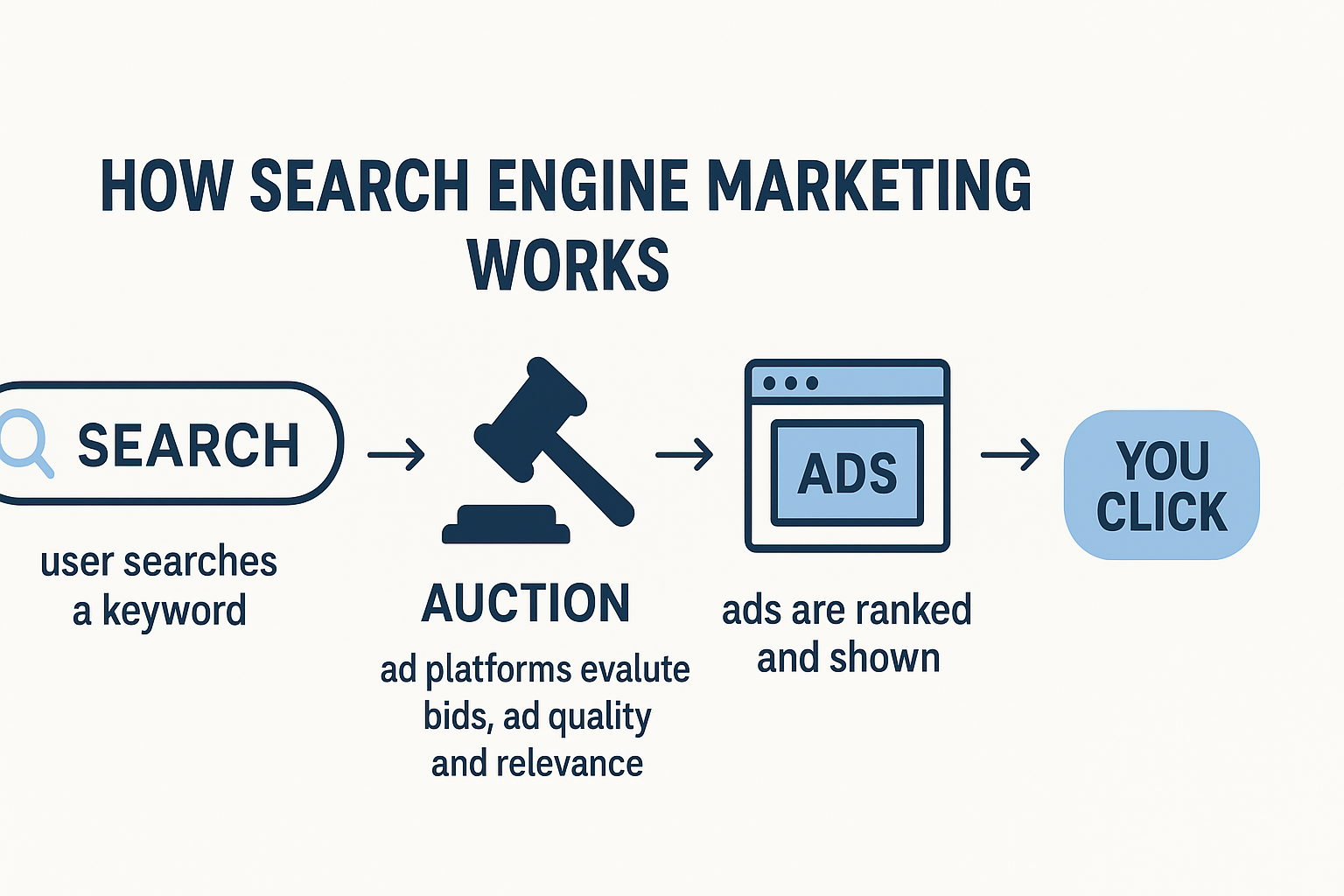
At its core, SEM is built around auction-based advertising. Here’s a simplified breakdown of the process:
- A user searches a keyword (e.g., “emergency plumbing services”).
- Google or Bing runs an instant auction among advertisers targeting that keyword.
- The ad platform evaluates bids, ad quality, and relevance.
- Ads are ranked and shown at the top (or bottom) of the results page.
You’re only charged when someone clicks on your ad.
The two most influential factors in this auction are:
- Maximum Bid: the highest a person is willing to pay for a click.
- Quality Score: a hidden metric combining ad relevance, expected CTR (click-through rate), and landing page experience.
The better your Quality Score is, the lower your costs and the higher your ad ranks—even if your bid is lower than a competitor’s.
Types of SEM Campaigns
SEM goes beyond just placing text ads on Google; let’s dissect the major types:
🔎 Search Ads
Text-based ads Google places at the top and bottom of the search results pages. They help capture high-intent traffic and users searching for your product or service.
🖼️ Display Ads
Visual banners placed on various sites within the Google Display Network (GDN). Perfect for building awareness and remarketing.
🛒 Shopping Ads
Product-based ads showing images, prices, and links. Commonly used by eCommerce businesses. They appear on Google search results and on the Shopping tab.
🎥 Video Ads
Appear on sites such as YouTube and can run before, during, or after videos. Great for storytelling and brand engagement.
📍 Local Service Ads
For businesses with local operations. They appear above search results and show reviews, phone numbers, and operational details.
📱 App Promotion Ads
Automated ads run on Google’s ecosystem (Search, Play Store, YouTube, etc.) to acquire app installs and users.
Keyword Research & Campaign Structure
An SEM project begins with well-planned keyword research. You must grasp the following aspects:
- How your client searches for the phrases and words.
- What phase the client is in the buyer’s journey.
- The amount of competition in every keyword.
High-intent and high-volume search phrases can be identified using Google Keyword Planner, Moz Keyword Explorer, and Google Trends.
After conducting the research, the next step is account structure, which is done in Google Ads:
- Campaigns – Broad strategy (e.g., brand awareness).
- Ad Groups – Thematic group (e.g., plumbing services, emergency repair).
- Keywords – The focus search words.
- Ads – The text/image shown to the users.
This structure provides excellent control on targeting and spending the budget.
How to Write Ads
The best copy uses relevance, emotion, and a strong call to action. The ad’s description should respond to the search with a surefire solution, urgent value, and end with strong action words like “Get a Free Quote,” or “Book Today.”
Ad extensions should also be used, since they increase ad visibility and offer further information such as location, phone number, and sitelinks.
The Function of Landing Pages
“Getting the click” is only part of the challenge. Capture users’ attention and ensure their experience is seamless and synchronized with the ad.
Your landing page must:
- Align with the ad’s primary message and associated keyword.
- Be mobile-friendly.
- Load under 3 seconds.
- Show trust indicators such as testimonials and social proof.
- Have a straightforward call-to-action (CTA).
- Present a clear and engaging headline.
A strong landing page enhances conversion rates and boosts the Quality Score simultaneously.
Why is SEM Important?
Purchases starting with a search engine proportion over 89%. SEM promotes brands to users who are primed to engage.
Additional Benefits:
- 🚀 Instant Visibility – Ads are activated immediately with the campaign launch.
- 🎯 Targeted Reach – Ads exclusively target users searching for your offerings.
- 📊 Measurable ROI – Impressions, clicks, and conversions can be tracked.
- 🧪 Test & Learn – Landing pages and ads are optimized continuously with A/B tests.
- 💰 Cost Control – Daily budgets and maximum bids are configurable.
Measuring SEM Success
You can’t improve something that you don’t track. Here’s what to monitor:
| Metric | What It Tells You |
|---|---|
| Impressions | How often your ad is shown |
| Clicks | How often it is clicked |
| CTR (Click-Through Rate) | Clicks ÷ Impressions; measures relevance |
| CPC (Cost Per Click) | Average cost you pay per click |
| Conversions | Desired actions (purchases, signups, etc.) |
| Conversion Rate | Conversions ÷ Clicks |
| Cost Per Conversion | How much you’re spending per result |
Aligning SEM data with revenue and customer acquisition using Google Ads and Google Analytics makes measuring success far easier.
SEM vs SEO: What’s the Difference?
| Feature | SEO | SEM |
|---|---|---|
| Visibility | Organic search | Paid search |
| Cost | Time/resources | Direct payment per click |
| Speed | Long-term strategy | Instant results |
| Control | Influenced by algorithms | Full control via campaigns |
| Longevity | Evergreen | Ends when you stop paying |
Bottom line: SEO builds the foundation, and SEM delivers fast, measurable wins. The best digital strategies include both.
FAQ: How Search Engine Marketing Works
What is SEM in simple terms?
SEM is the process of placing paid ads in the search results to drive traffic to your website.
How is SEM different from SEO?
While SEO earns exposure over time, SEM pays for it.
How much does SEM cost?
Costs differ by industry and location. Your budget is within your control, and you only pay when someone clicks.
Which platforms support SEM?
Google Ads is the most popular choice. Bing Ads and YouTube also support SEM campaigns.
Can SEM work for small businesses?
Yes. Even small businesses with limited budgets can benefit from SEM with local and niche targeting.
How Zenith Point Can Help You Succeed with SEM
At Zenith Point Digital Marketing, we develop specialized SEM campaigns to meet your business objectives. Our team handles everything from ad budget allocation to keyword targeting, ad writing, and account assessment to guarantee optimal performance—ensuring every click turns into a desired action.
We don’t merely launch ad campaigns. We combine insights with our expertise to design result-centric strategies that achieve your goals. Whether you need quick boosts to your business or cost-effective lead generation, Zenith Point delivers.
📈 Get in touch to optimize your business traffic profitably and strategically.